
Overview
This paper tells the story of how AISDLC was conceived, designed, and built at Aventude, the thinking behind every phase, the reasoning behind every agent, and the principles that shaped how AI and human judgement are combined throughout the process. It's not a product brochure. It's an honest account of what it took to build a software development lifecycle that is genuinely AI-native, rigorously structured, and responsible by design.
The problem We set out to solve
AI has entered software development as a tool. We asked whether it could be the process itself.
The first version of the question Aventude asked was: how do we use AI to make our teams faster? It was the wrong question. It's the question most engineering organisations are still asking, and it leads to the same destination, a collection of AI-assisted tools sitting on top of an unchanged process. Slightly faster. Fundamentally the same.
The right question, the one we eventually arrived at, was different: if you were designing a software development lifecycle from the ground up today, knowing what AI agents can do, what would you build? Not which steps would you add AI to. What would the whole thing look like if AI capability was a design input rather than an add-on?
That question opened up a completely different space. And it led to Aventude AISDLC.
What was broken in traditional development
Before we could design something better, we had to be honest about what was broken. Not broken in an unusual or exceptional way, broken in the ordinary, persistent way that everyone in engineering has learned to work around. So we talked to all our Software engineers, UX designers, Quality engineers, Project managers, Architects and Product managers.
Our findings:
- Discovery takes too long. Weeks of manual archaeology before any plan can form. Codebases grow, documentation drifts, and the actual shape of a system becomes something only a few people fully understand, if anyone does.
- Assumptions travel silently. From an idea to an architecture to a spec to a build, the original intent loses fidelity at every handoff. What arrives at delivery is rarely exactly what was imagined at the start.
- Testing is sequential. Build first, test after. Problems discovered late cost more to fix than problems discovered early, and sequential testing guarantees late discovery.
- Specs are human-paced. Writing detailed, unambiguous specifications for every work item is one of the most time-consuming parts of the delivery process. And they're still often incomplete.
- Quality is a phase. In most processes, quality is checked at the end rather than built into every step. That is structurally backward.
None of these problems are new. Engineers have known about them for decades. What was new was the realistic possibility of solving them, not by adding AI tools to the existing workflow, but by redesigning the workflow around what AI agents can now reliably do. The question was not how to make developers faster. It was how to compress the whole process, including the parts that had nothing to do with writing code.
The principles We designed around
Before the first agent was defined, we established what the process had to be, non-negotiably.
AISDLC was designed from five principles. Every agent, every gate, every phase was evaluated against them. When a design decision conflicted with a principle, the design changed, not the principle.
AI-native, not AI-augmented
This was the foundational decision. AISDLC is not a traditional software development process with AI tools inserted into certain steps. Every phase is designed around what AI agents can produce. The inputs, outputs, and structure of each phase are defined by agent capability, not adapted from a pre-AI model of how software gets made.
Outputs
Implication: Agents are not productivity tools. They are structural components of the lifecycle.
Humans lead. Agents execute.
The most important decisions in software development are not the most automatable ones. What should we build? Why are we building it this way? Does this output actually meet the standard? These questions require human judgment, and AISDLC is architected so that humans make them at every critical point. Agents cannot progress past a gate without human approval. That is structural, not advisory.
Outputs
Implication: The quality of the process depends on the quality of human decisions, not the absence of them.
Problems surface early or not at all.
The cost of fixing a problem in software development is roughly proportional to how late it's discovered. AISDLC is designed so that structural problems, misaligned concept, wrong architecture, incomplete spec, cannot travel forward into later phases. Every phase has a gate. Every gate has a human. Problems that reach the gate get resolved before they reach the next phase.
Outputs
Implication: Quality is built into structure, not checked at the end.
The process must work in both directions.
Aventude builds two types of software engagements: new products from ideation, and modernisation of existing systems. A single lifecycle needed to work for both, not as a compromise that partially fit each, but as a coherent design with a shared foundation and path-specific phases where the work genuinely differs.
Outputs
Implication: The shared phases are where most of the engineering lives. The path-specific phases are where the real differences are honoured.
Nothing is lost between handoffs.
One of the least visible but most damaging failure modes in software development is context loss between phases. A decision made in architecture doesn't reach the spec. A nuance in the spec doesn't reach the developer. AISDLC is built on the our AI Platform specifically because it maintains full context across all phases, every decision, revision, and artefact is available to every subsequent agent.
Outputs
Implication: The process has memory. Agents work with the whole picture, not just what was last handed to them.
Two paths. One lifecycle.
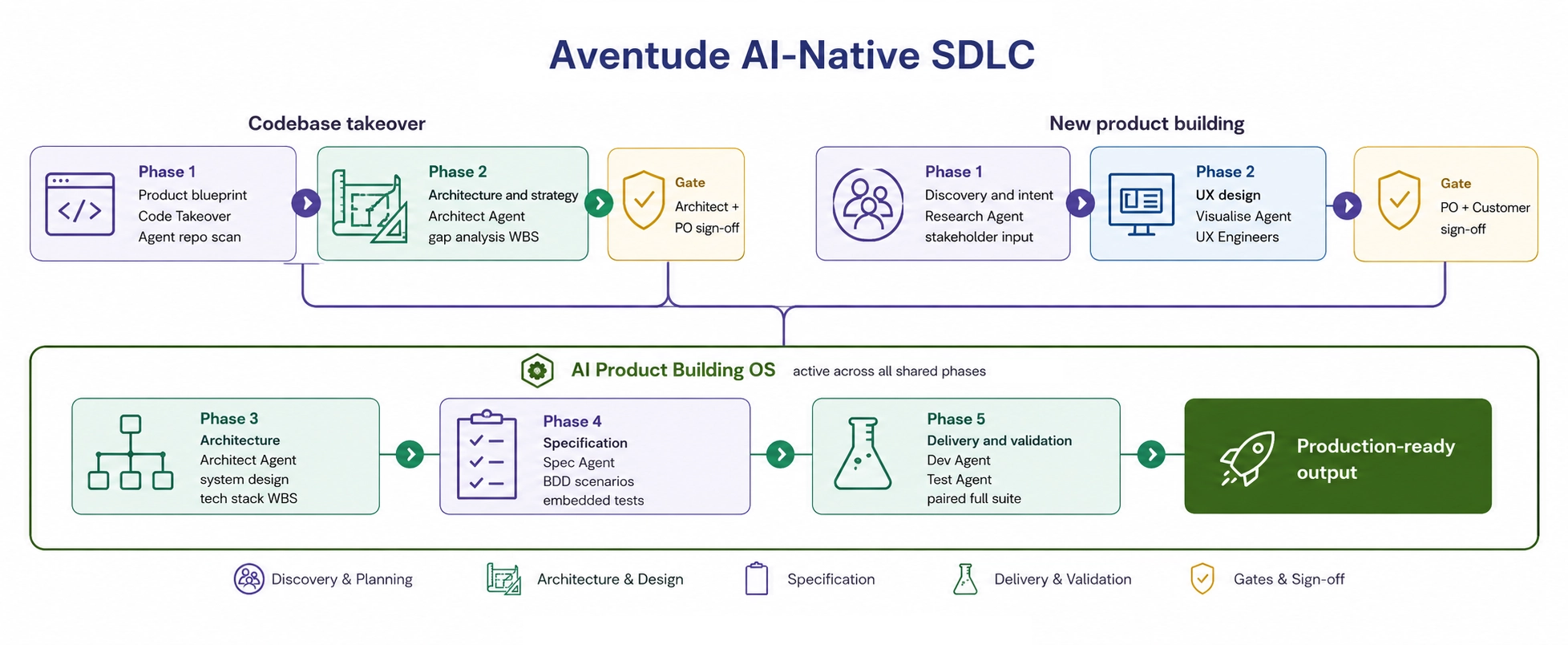
The first structural decision: AISDLC is not one process. It's two paths that converge into a shared foundation.
Aventude builds new products from scratch, and it modernises systems that already exist. These are genuinely different engineering problems, not different in scale or complexity, but different in kind. A new product development process must start with an idea and make it real. A modernisation process must start with a system and understand it before deciding what to do with it.
We considered building two separate lifecycles. We considered building one process that tried to accommodate both. Neither was right. What we built instead is two distinct paths for the phases where the work genuinely differs, converging into a shared set of phases for the work that is fundamentally the same regardless of which path you entered from.
Path 1: New product development
The central challenge of building a new product is not technical. It's keeping the original intent intact through every phase of the process. Ideas lose fidelity. Assumptions travel silently. Scope drifts. The product that arrives at delivery is rarely exactly what was imagined, and the gap between them is rarely discovered until it's expensive to close.
AISDLC Path 1 is designed to close that gap structurally. Before any architecture is drawn or any line of code is written, the idea goes through two distinct stages, each followed by a human verification gate, that make the product real before it's built.
The new product path at a glance
Ideation Agent
Turns a raw idea into a structured product concept through dialogue with the product owner. Captures the problem, the users, the value proposition, and the assumptions that still need testing. The agent asks the hard questions, the ones that are easy to skip in the rush to start building.
Verification 1 · PO + Customer
Hard stop. The concept is presented to the product owner and customer. Nothing is designed until both formally confirm it reflects what they want to build. The Ideation Agent revises as many times as needed.
Visualisation Agent + UX engineers
The confirmed concept becomes a visible product, wireframes, hi-fidelity mockups, annotated interaction flows, through collaboration between the Visualisation Agent and Aventude's human UX engineers. The agent generates at speed. The engineers bring judgment, accessibility thinking, and craft.
Verification 2 · PO + Customer
Hard stop. The designs are presented iteratively until both parties confirm them. When this gate passes, the designs are frozen. What was confirmed is what gets built. Scope drift, the most common reason products disappoint, is eliminated structurally.
New Product Blueprint
A complete product blueprint is generated: user types, usage flows, feature backlog, story backlog, architecture recommendations, and tech stack guidance, structured across Architecture Principles. Built forward from the confirmed vision. Carried into the shared phases without loss.
Path 2: Codebase takeover and modernisation
The central challenge of modernising an existing system is not the code. It's knowing what you are actually starting from. Codebases accumulate. Documentation drifts from reality. The system that exists is rarely the system that anyone thinks exists, and every architectural decision made on false assumptions propagates that falseness forward.
AISDLC Path 2 starts by removing that problem entirely. Before any human architect makes any decision about what the system should become, the Code Takeover Agent produces a complete, structured picture of what it actually is, straight from the repository, with nothing filtered through selective memory or outdated documentation.
The codebase takeover path at a glance
Code Takeover Agent
Reads the entire repository on connection. Identifies user types from authentication guards and role annotations. Maps features from route definitions and controller logic. Traces all integration points. Surfaces the full tech stack. Analyses the structural health of the codebase. Produces a complete, structured product blueprint within the hour, with nothing lost in translation.
Architect + PO review · Human gate
The human architect and product owner review the blueprint with the customer. They confirm the picture is accurate, note where it surprises them, and begin the conversation about what needs to change, and why.
Strategic intent · Human decision
The architect and PO define the strategic intent, the reason for change and the target outcome. Cloud transformation. Scalability fix. Microservices migration. UX upgrade. The intent shapes every subsequent architectural and delivery decision. If the intent is UX, the Visualisation Agent activates for a parallel design and verification path before engineering begins.
Architect Agent: Gap Analysis + Roadmap
The Architect Agent runs a formal gap analysis, comparing current to target state, mapping risks and dependencies, and proposing a target architecture and sequenced roadmap with a work breakdown structure to the smallest executable unit. Every proposal is interrogated and refined through conversation with the human architect until the plan is sound. Nothing locks until the architect says so.
The platform AISDLC runs on
AISDLC required a platform for building AI agents.
As the design of AISDLC matured, it became clear that no existing AI platform could support what we needed. The requirements were specific: multi-agent orchestration with structured handoffs, bidirectional feedback across all phases, persistent context across the full lifecycle, and human-in-the-loop gates that were structural rather than advisory.
General-purpose AI platforms were built for single-turn or short-context interactions. They were not designed for the demands of a multi-phase, multi-agent engineering workflow where the output of Phase 1 must be available and intact in Phase 4, and where a human decision in Phase 2 must constrain what an agent can do in Phase 3.
It's not just an AI agentic platform, it's a Product Building OS.
It serves as the core intelligence layer for product engineering, grounded in the single source of truth: the codebase itself.
By continuously understanding architecture, implementation, dependencies, and engineering context, it becomes the operational brain behind the entire software development lifecycle. Aventude's AISDLC agents are built on top of it, leveraging this foundational intelligence to enable autonomous engineering workflows, contextual decision-making, and scalable product delivery.
What our platform provides
Multi-agent orchestration
Agents in AISDLC are not independent tools that happen to be used in sequence. They collaborate, hand off, and in certain configurations check each other's work, the Test Agent running against the Dev Agent's output in real time is one example. It provides the orchestration layer that makes this possible.
Persistent context across phases
Every decision, revision, and artefact produced in every phase is available to every subsequent agent. The Spec Agent knows what the Architect Agent decided. The Dev Agent knows what the Spec Agent specified. Nothing is lost between handoffs, which is one of the most common and least visible failure modes in software delivery.
Bidirectional feedback loops
AISDLC is not a waterfall with AI agents. Every phase is connected in both directions. Outputs that do not meet the bar flow back upstream, never forward, so quality gates are never bypassed. It enforces this directionally at the platform level.
Human-in-the-loop by architecture
The human decision gates in AISDLC are not conventions or best practices. They are structural features of our platform. An agent cannot progress past a gate without a human action. This is not configurable. It's the responsible engineering guarantee that AISDLC is built on.
What we learnedBuilding it
Building AISDLC taught us things we did not expect to learn. Some of them changed the design significantly.
The verification gates were the hardest design problem
The verification gates were the hardest design problem The original design had one verification gate per path. Experience showed we needed two for the new product path, one after ideation and one after visualization, and that the gates needed to be genuinely hard stops, not recommendations. The temptation to move a gate downstream to keep momentum going is real and constant. The gate's value is precisely its resistance to that pressure.
We also learned that the quality of what happens at a gate depends almost entirely on what arrives at it. An Ideation Agent that produces a vague or incomplete concept produces a gate review that is inconclusive. The agents and the gates are co-dependent: good gates require good agents, and good agents require well-designed gates to anchor their outputs to.
Human judgment cannot be engineered out, and should not be
Early in the design process there was a version of AISDLC that tried to minimize the human decision points in the interest of speed. We moved away from this not because it was technically infeasible but because it was conceptually wrong. The value of having a human architect approve an architectural decision is not the decision itself, it's the accountability that comes with it. An AI agent cannot be held accountable for a system that fails in production. A human architect can.
AISDLC is faster than traditional development not because it removes humans but because it removes the low-value human work, manual discovery, spec writing, repetitive QA, and concentrates human attention on the decisions that genuinely require human judgment.
The blueprint is the most important artefact in the process
Whether it's generated from a codebase or built forward from an idea, the product blueprint is the document that everything else depends on. A weak blueprint produces a weak architecture. A weak architecture produces weak specs. Weak specs produce code that does not do what the product owner intended. The quality of the process flows from the quality of the blueprint.
This insight shaped how much effort we put into the Code Takeover Agent and the Ideation Agent. They are not discovery tools. They are the foundation of every decision that follows.
The paired Dev and Test model required a rethinking of how specs are written
You cannot run tests in real time against code being produced if the test cases are not written before the build begins. This sounds obvious, but it has a significant consequence: the Spec Agent must produce test cases of sufficient quality and specificity to be machine-executable, not just human-readable acceptance criteria. This raised the bar on what a spec needed to contain, which in turn raised the bar on what the Architect Agent needed to produce as inputs to the Spec Agent.
The whole process is a chain. The quality of each link constrains and is constrained by the links adjacent to it.
The bigger Picture
AISDLC is not the final answer to how software should be built with AI. It's our best current answer, designed to evolve.
We believe the industry is in the middle of a transition that most engineering organisations have not yet fully reckoned with. AI tools have arrived faster than the processes that should govern them. The result is that many teams are building software faster, but not necessarily building better software, or building it more responsibly.
The distinction between AI-augmented and AI-native development is not semantic. In an AI-augmented process, AI makes individual steps faster but the process retains its original shape, sequential, human-paced, with the same structural failure modes in different clothes. In an AI-native process, the design starts from what AI agents can reliably produce and works outward from there. The shape of the process is different. The failure modes are different. The relationship between human and machine decision-making is different.
AISDLC is Aventude's commitment to the second category. It's not a product roadmap. It's a statement of how we believe software should be made, responsibly, rigorously, with humans genuinely in control of the decisions that matter and agents genuinely responsible for the work that should not require human time.
What AISDLC is not
- It's not autonomous. Agents cannot progress past human gates. The human architect's judgment is structural, not optional, at every critical point.
- It's not faster by cutting corners. The verification gates, the spec review, the architect's final sign-off are not overhead, they are the mechanism by which quality is maintained. Speed comes from removing low-value work, not from skipping high-value decisions.
- It's not a tool or a platform. AISDLC is a process. Our platform is what it runs on. The two are distinct. Aventude provides both.
- It's not finished. Every engagement teaches us something. The process will evolve. The principles will not.